
When a hire fails, everyone reviews the candidate. Almost nobody reviews the hiring model. Yet in our experience, choosing contract when the problem needed permanent — or vice versa — is behind a large share of placements that don't survive the year.
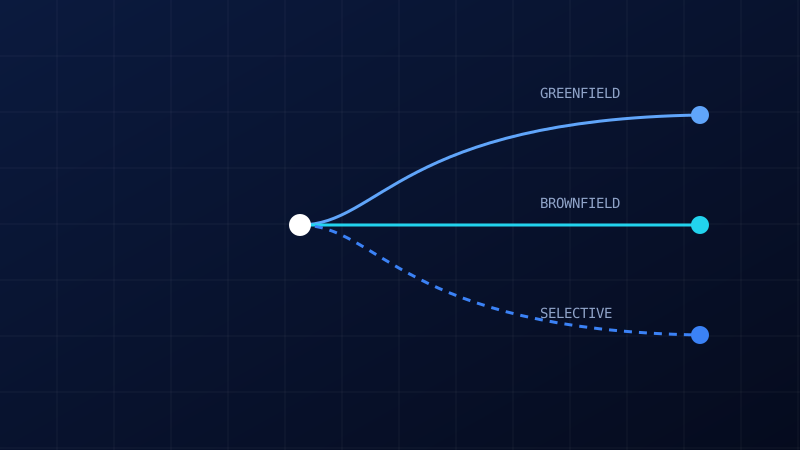
The three models are not interchangeable routes to the same seat. They are answers to three different questions, and the discipline is asking which question you actually have.
Contract answers: "I have a defined problem with an end date"
A migration, a rollout, a backlog burn-down, a maternity cover. The work has a shape, the shape has an end, and what you need is proven capability that arrives fast and leaves clean.
Where contract goes wrong is when it's used as a permanent hire with an escape hatch. A contractor treated as a temporary employee — vague scope, indefinite horizon, no defined outcome — combines the cost premium of contracting with the ramp-up cost of a permanent hire, and delivers the benefits of neither.
If you can't write down what "done" looks like, you don't have a contract role. You have a permanent role you're afraid to commit to.
Contract-to-hire answers: "The stakes are high and the signal is weak"
C2H exists for exactly one situation: a role important enough that a mis-hire is expensive, where interviews alone can't give you confidence. Three months of real work together is the best interview process ever devised — both directions. The candidate is evaluating you too, and conversions stick because both sides chose with full information.
Two rules keep C2H honest. First, the conversion terms are agreed up front — rate, timing, and what triggers the decision — so month three isn't a negotiation ambush. Second, you treat the person as a future colleague from day one. Teams that hold C2H consultants at arm's length get arm's-length performance, then wrongly conclude the model failed.
Permanent answers: "This capability is part of who we are"
Institutional knowledge, systems that need an owner for years, roles where the value compounds — these justify the slower process and the onboarding investment of a permanent hire. The test is simple: will this work still exist, in roughly this form, in three years? If yes, rent-versus-buy math favours buying.
The common failure here is the opposite of the contract failure: hiring permanent for spiky work. A permanent hire for a two-year implementation leaves you, in year three, with a salary attached to a project that ended.
A decision table we use with clients
- End date visible, skills provable in interview — contract.
- No end date, mis-hire is expensive, signal is weak — contract-to-hire.
- No end date, capability is core, knowledge compounds — permanent.
- End date visible but the skill is rare — contract, but plan the knowledge transfer explicitly, because that person will leave with everything they know.
One more variable: the market
In tight markets, strong candidates in some specialisms simply won't consider permanent roles — the contract premium is too good. A hiring plan that ignores what the talent side wants isn't a plan; it's a wish. Ask your staffing partner what the market for this skill actually accepts right now.
The takeaway
Pick the model before you brief the role. It changes the rate, the sourcing pool, the screening emphasis and the onboarding plan. Getting it right costs one honest conversation. Getting it wrong costs a quarter — and usually a good person's goodwill with it.