
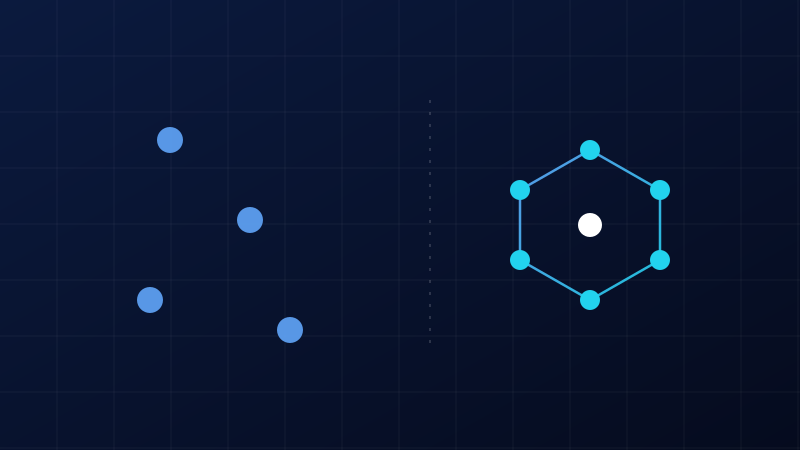
Both models put skilled people on your problem. The difference is where accountability lives — and choosing wrong doesn't fail loudly. It fails as a slow leak: velocity that never quite materialises, or overhead that never quite pays off.
Augmentation: your process, our people
Staff augmentation works when the constraint is purely capability or capacity: your delivery machine is healthy, your leads are strong, you simply need two more senior engineers or an ABAP developer for the integration sprint. The consultant plugs into your standups, your codebase, your definition of done. Accountability for outcomes stays exactly where it was — with you.
It breaks when it's used to patch a broken delivery process. Adding rented engineers to a team with unclear priorities and weak technical leadership produces more code and the same outcomes. If your own engineers aren't shipping, augmentation buys you more people not-shipping.
Pods: our process, our accountability
A managed pod is a different contract — literally and structurally. The pod arrives with its own lead, its own working rhythm, and ownership of a defined scope. You manage the what; the pod manages the how. Reporting is against outcomes: milestones hit, defect rates, cycle time — not hours logged.
Pods win when you need a parallel workstream your organisation can't spare leadership for — a modernization, a migration, a product line — or when you want delivery capacity in a different cost geography without building a captive centre. They break when the scope is undefined; a pod without a clear charter degenerates into expensive augmentation with extra management layers.
The test in one question
If this workstream slips, whose name is on the slide? If it's your delivery manager — augment. If you want it to be your partner's — pod.
Three traps either way
- The pod that's really scattered augmentation. Five people across five of your teams is not a pod, whatever the invoice says. No shared scope, no real accountability.
- The augmentation that's really an abdication. If a vendor's contractors outnumber your employees on a system you consider core, you've outsourced the capability without deciding to.
- Ignoring the conversion path. Good models evolve — augmentation into a pod as trust grows, a pod into your own hires as the capability becomes core. Agree up front how people and knowledge transfer, so evolution isn't a renegotiation.
We sell both models, so we have no horse in this race — except one: clients who choose deliberately renew, and clients who drift into the wrong model churn. The deliberate choice takes one honest hour at the start. Take the hour.